Capacity, Materials and Carbon Costs Are Converging on North America’s Cement Industry, Making the Case for Disruption. The Question Is Whether an Incremental Response Is Enough.
By Jonathan Rowland
The United States imports almost a quarter of the cement it uses. With “Made in America” supported on both sides of the political aisle, is there a wave of new clinker capacity on the horizon? A ripple, perhaps.
Heidelberg Materials’ plant in Mitchell, Ind., opened in 2023; GCC’s expansion of its Odessa plant in Texas started up in June, built specifically to reduce reliance on imported cement; and Eagle Materials’ new clinker line at Laramie, Wyo., is expected online this year, too. But for most producers, the response is to debottleneck and modernize existing assets — squeezing more output from plants already running — rather than adding new clinker capacity.
Meanwhile, still stung by the collapse in cement demand after 2008, CAPEX is flowing into (cheaper-to-install) grinding capacity and import terminals, entrenching import dependence. Turkish producer Çimsa opened an $82 million grey cement grinding plant in Houston in October 2025, grinding clinker shipped in from the company’s international operations — consistent with a broader pattern of Turkish producers redirecting supply toward the United States as the EU’s Carbon Border Adjustment Mechanism raises the cost of clinker exports into Europe.
Elsewhere, the Ash Grove and Alamo Cement joint venture, Houston Cement Co., was formed specifically to import cement via a $42 million-plus facility on the Houston Ship Channel. Silvi Cement’s new bulk import terminal at Morehead City, N.C., will handle five times current cement volumes. SESCO Cement opened a comparable facility at Tampa Bay, Fla., in mid-2026. And Cemex has just completed a $36 million expansion of its own Tampa Bay terminal.
One alternative lever for increasing domestic U.S. output — reducing the clinker factor in cement by using supplementary cementitious materials such as fly ash and slag — is also under long-term pressure. Fly ash and slag are byproducts of shrinking industries, as coal-fired power plants close and steelmaking shifts toward electric arc furnaces that do not generate blast-furnace slag the same way. Investment is chasing that supply. Ozinga broke ground in 2025 on a 1-million-ton-per-year slag-cement plant in east Chicago, built around the largest vertical roller mill in North America.
Decarbonization presents another interconnected challenge, most directly in Canada, where the federal industrial carbon price is set to rise from C$95 per ton in 2026 to C$130 per ton by 2035. The Cement Association of Canada’s Roadmap to Net-Zero Carbon Concrete commits the industry to eliminating more than 15 million tons of cumulative emissions by 2030.
The American Cement Association’s (ACA) parallel Roadmap to Carbon Neutrality, backed by the majority of U.S. cement capacity, targets carbon neutrality across the cement and concrete value chain by 2050. A key element in this is cutting the clinker ratio from 90% to 75% by 2050, stretching SCM supply.
Domestic capacity that can’t easily expand, a key input under structural pressure, rising and increasingly trade-relevant carbon costs, and a cost base where efficiency gains are outsized: on paper, that is an industry ripe for a wave of disruptive innovation.
The Incremental Case
Alfred Lam is a partner in industrial venture capital fund Chrysalix, which has backed industrial startups for more than two decades. In his view, innovation will be successful first when it fills existing gaps. The fly ash and slag squeeze described above is the kind of constraint he looks for: “economic first, but with a decarbonization output,” as he put it.
Having worked with investors including Shell in energy, Mitsubishi, Caterpillar, Teck Resources and Hitachi in mining, and FLSmidth (now Fuller Technologies) and Siam Cement Group in cement, he also brings a cross-sectoral view, solving one industry’s challenge using another’s problem.
Carbon Upcycling Technologies is a working example of this economics-led innovation: mineral waste feedstocks reprocessed into SCM to replace shrinking fly ash and slag suppliers, backed by both CRH Ventures and, through its accelerator, Holcim MAQER. It’s incremental in the sense that it doesn’t touch how clinker is made. But it is real capital, aimed at a real constraint, delivering a real emissions benefit.
The same logic extends beyond cement’s own supply chain. Lam pointed to Mangrove Lithium, a Vancouver-based lithium refiner that he co-founded and serves on its board. Mangrove’s waste byproduct — delithiated beta spodumene, left over from processing hard-rock lithium ore — is being engineered into a clinker substitute, cutting cement’s carbon footprint by up to 20%. It is the kind of cross-sector opening Chrysalix looks for: one industry’s waste problem solving another’s supply constraint, with cement producers as the customer rather than the innovator.
And when it comes to taking such innovation through to full commercialization, “it often does take that village,” Lam said: government grants to de-risk an idea from lab to first pilot, venture money to build the company and absorb early risk, and corporate partners to bring commercial scale once that risk has come down.
Is this all enough, though? Thomas Petithuguenin, CEO of concrete-upcycling startup Everox, another company backed by Chrysalix, which led its seed funding round, thinks something more disruptive is needed to solve the industry’s challenges.
The Radical Case
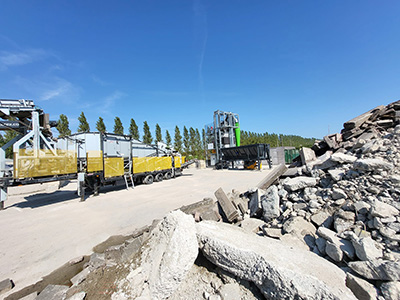
Petithuguenin’s bar for disruption is higher: a massive drop in clinker factor and/or cement consumption, or in the CO2 footprint of production itself. His company, Everox, turns recovered cement from demolished concrete into Activated Cement Paste, an SCM designed to replace up to 35% of new cement.
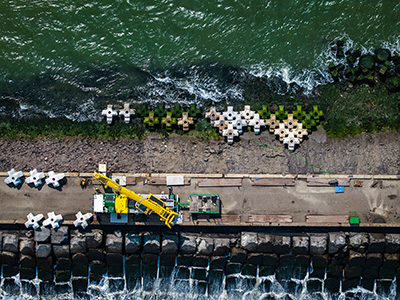
In 2025, Everox participated in long-term material testing in the Living Lab at the South Pier in IJmuiden, the Netherlands, where blocks of 30% Everox SCM achieved a 28-day compressive strength of 52.3 MPa, meeting the C40/50 structural strength class. Recovered near the cities that generate the waste — and capable of substituting directly for the fly ash and slag now in short supply — the material turns a global commodity market into a local, circular one.
It is a vision Petithuguenin has held for a while. In a 2021 interview, while still FLSmidth’s head of Research and Partnerships for Cement, he described a cement industry built around decentralized, even mobile, production using whatever waste materials were available locally — mine tailings, demolished concrete, industrial byproducts — rather than a single standardized global process.
The obstacle then, he said, was not technology or regulation, but the lack of vertical integration across the industry: every link in the chain protecting its own margin, each with a slightly different, not necessarily compatible vision of the future.
Petithuguenin remains skeptical of incumbency, arguing that corporate venture money tends to reinforce the existing model. Clinker is also not necessarily the focus of many corporate funds. Across a quick survey of more than 60 disclosed investments by Holcim, Cemex and CRH’s venture arms, only about a third target clinker directly — through kiln electrification, carbon capture or SCM substitution.
The rest sit closer to the edges of the business, in site robotics, logistics platforms and, in Holcim’s case, back-office operations (invoicing, supply chain, etc.). Holcim’s collaboration with SaltX Technology to build what the companies describe as the world’s first fully electric cement plant, replacing fossil-fuel combustion with a plasma-based process, would be an exception to the rule here.
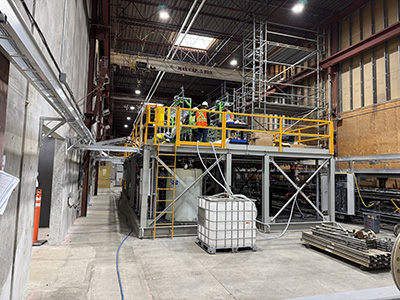
Publicly funded projects follow the same pattern: Norway’s Brevik facility, the world’s first industrial-scale CCS installation in cement, took a little more than a decade from feasibility study to first shipment and now captures around half of one plant’s emissions. This is meaningful at the plant level, Petithuguenin argued, but marginal compared with an industry emitting roughly 1.5 billion tons of CO2 a year. “We cannot solve the problems created by modern, energy-intensive industry by adding another layer of energy-intensive industry on top of it,” he said.
There is also an asymmetrical risk profile, Petithuguenin added. His own plant was delayed a year by permitting, a setback a major producer could absorb without much difficulty, but one that can threaten a startup’s entire trajectory.
Established businesses can absorb stagnation costs, draw on prior experience with the same permitting hurdles, and deploy public-affairs and legal teams that startups typically cannot. That heightened risk profile is part of what venture capital helps to bridge. But there is a deeper funding issue that awaits between those early days and successful commercialization.
The Missing Middle
Lam’s own diagnosis of what’s holding back innovation is not technology or even ambition: it is capital, at a specific stage. Early-stage grant funding is available, he said, and so is early venture capital; what’s scarce is the late-stage, capital-intensive financing that a first-of-a-kind plant needs to move from demonstration to commercial construction. “The risk appetite is still triangulating,” he said. Solve that gap — what he called “the missing middle” — and much of what currently reads as industry-wide reluctance might resolve itself.
Lam sees this playing out differently by geography, too. North American investors, in his experience, are more willing to back big, bold visions, while European investors tend to be more conservative, wanting deeper proof points before committing. Whether that greater risk appetite extends specifically to the missing middle, where the needed capital looks more like project finance than venture capital, is a separate (and open) question.
Where Lam and Petithuguenin converge most closely is in their view of the role of cement majors. Ultimately, neither expects these to disrupt themselves from the inside. Lam framed it gently: incumbents, he said, are more likely to end up as “the user of the innovation” than its producer. Petithuguenin agreed, with a sharper edge: engagement is increasing, he acknowledged, but too often reads as “developing options” rather than a commitment to disruption.
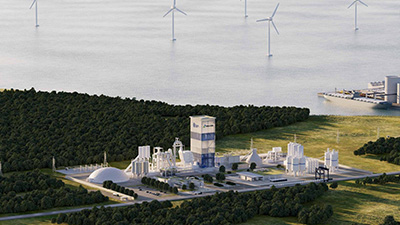
Looking five to 10 years out, Petithuguenin’s own answer is less about who wins the incremental-versus-radical argument than about what gets funded in the meantime. Public capital, he argued, should go toward whichever solutions deliver the greatest cumulative emissions reductions, replicate fastest and depend least on ongoing subsidy — a bar that a maturing crop of startups, including his own, is now beginning to meet.
For an industry that cannot build its way out of a capacity shortfall and is running short on the material it needs to stretch what it already has, that argument may carry further than the climate case ever did.